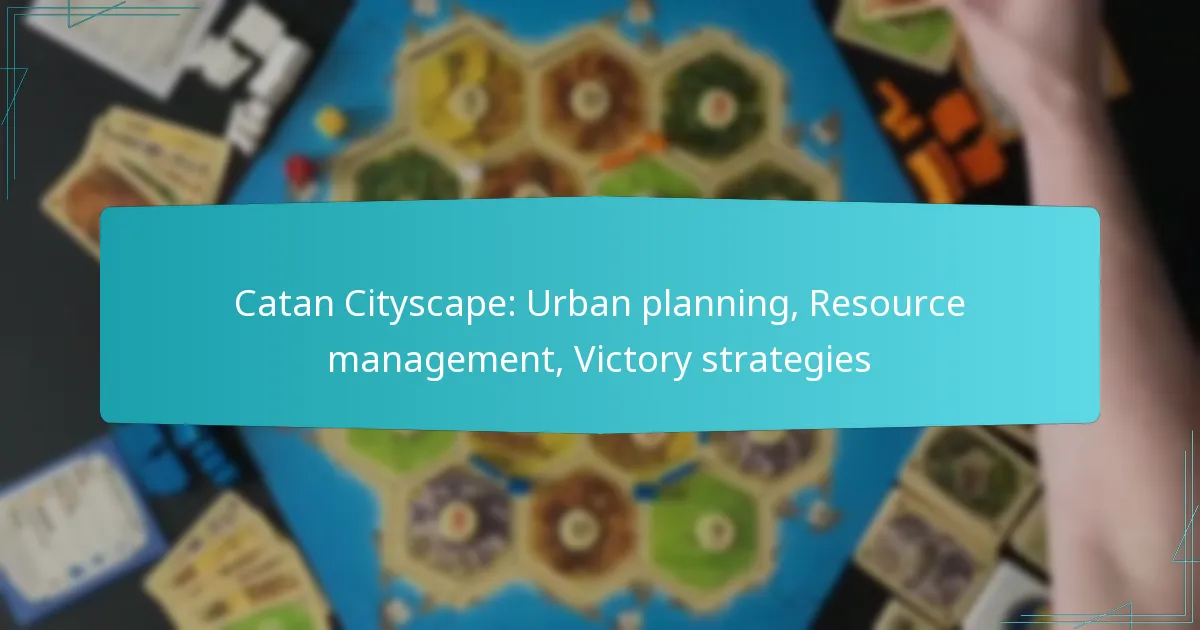
Catan Cityscape emphasizes the importance of urban planning, where players strategically place settlements and manage resources to enhance their cities. By optimizing city layouts for resource access and minimizing competition, players can gain a competitive edge. Successful victory strategies combine effective resource management with adaptability, focusing on securing victory points through various means while responding to opponents’ moves.
What are the key principles of urban planning in Catan?
Urban planning in Catan revolves around strategic placement of settlements, efficient resource management, and thoughtful expansion. Players must consider how to optimize their city layouts to maximize resource access while minimizing competition from opponents.
Understanding settlement placement
Settlement placement is crucial for establishing a strong foundation in Catan. Players should prioritize locations that provide access to a variety of resources, particularly those that are scarce on the board. Aim for intersections that combine high-probability resource tiles to increase production chances.
Consider the balance between resource diversity and the number of settlements. A well-placed settlement on a 6 or 8 tile can yield consistent resources, while a settlement on a 3 or 11 tile may produce less frequently. Placing settlements near ports can also enhance trade opportunities.
Factors influencing city expansion
City expansion in Catan is influenced by several factors including resource availability, road placement, and competition. Players should assess their current resources and future needs when deciding where to build cities. Expanding towards high-value resource tiles can significantly boost production.
Another important factor is the positioning of roads. Building roads towards potential city locations not only secures expansion opportunities but also blocks opponents from accessing key areas. Monitor opponents’ movements to anticipate their expansion plans and adjust your strategy accordingly.
Optimal road placement strategies
Effective road placement is essential for controlling territory and facilitating expansion. Players should aim to build roads that connect settlements and cities, creating a network that allows for easy access to resources and potential new settlements. Prioritize routes that lead to high-value tiles or ports.
- Build towards unclaimed resource tiles to secure future settlements.
- Block opponents by placing roads strategically to cut off their expansion routes.
- Consider the Longest Road bonus as a potential victory point when planning road placement.
Be cautious of overextending your roads without securing settlements, as this can leave you vulnerable to resource shortages. Always evaluate the trade-offs between immediate expansion and maintaining a balanced resource base.
Balancing resource access and competition
Balancing resource access while managing competition is a key aspect of gameplay in Catan. Players must ensure they have a steady supply of essential resources like wood, brick, wheat, ore, and sheep. Diversifying resource access can help mitigate the impact of a blocked tile or a well-placed robber.
Monitor opponents’ resource production and adjust your strategy accordingly. If an opponent is heavily reliant on a specific resource, consider trading with them to gain an advantage or blocking their access through strategic settlement placement.
Utilizing terrain advantages
Terrain advantages play a significant role in urban planning within Catan. Different terrain types yield varying resources, and understanding these can help players make informed decisions. For instance, hills provide brick and wood, while fields yield wheat, which is essential for building cities.
Players should prioritize settlements near high-frequency resource tiles, such as those marked with 6s and 8s. Additionally, leveraging ports can enhance trade capabilities, allowing players to convert surplus resources into what they need most.
Be aware of the terrain layout when planning expansions. Positioning settlements near diverse terrain types can create a more resilient strategy, ensuring access to a broader range of resources throughout the game.
How does resource management impact gameplay in Catan?
Resource management is crucial in Catan as it directly influences players’ ability to build settlements, cities, and roads. Effective management of resources can lead to strategic advantages, while poor handling can result in missed opportunities and setbacks.
Types of resources and their significance
Catan features five primary resources: wood, brick, wheat, sheep, and ore. Each resource plays a unique role in gameplay; for instance, wood and brick are essential for building roads and settlements, while wheat is necessary for settlements and cities. Ore is vital for upgrading settlements to cities, and sheep are used for development cards.
Understanding the significance of each resource helps players prioritize their collection strategies. For example, if a player aims to expand their road network, they need to focus on acquiring wood and brick. Conversely, if they want to build cities, they should prioritize wheat and ore.
Strategies for efficient resource collection
To collect resources efficiently, players should aim to place their settlements on hexes that yield a variety of resources. Ideally, settlements should be positioned to access multiple resource types, especially those that are scarce in the game. This diversity allows for a more balanced resource intake.
Utilizing the number distribution on the hexes is also crucial. Settlements adjacent to hexes with higher probability numbers (like 6 and 8) will yield resources more frequently. Players should consider trading with others to fill gaps in their resource collection, especially if they have an abundance of a specific resource.
Trading tactics with other players
Trading is a vital aspect of Catan that can significantly enhance resource management. Players should assess their own resource needs and those of their opponents to create mutually beneficial trades. Offering resources that are abundant for you but scarce for others can lead to favorable exchanges.
Timing is essential in trading. Players should trade when they have leverage, such as when they hold a resource that is critical for another player’s plans. Additionally, players should be cautious about revealing their strategies during trades, as this can give opponents insight into their future moves.
Managing scarcity and abundance
Scarcity can dramatically affect gameplay in Catan. When certain resources are in short supply, players may need to adjust their strategies, such as focusing on development cards or building roads to block opponents from accessing key resources. Recognizing when a resource is scarce allows players to pivot their plans effectively.
Conversely, managing abundance is equally important. If a player has an excess of a particular resource, they should actively seek trades to convert that surplus into needed resources. Players should also consider using their surplus to build roads or settlements quickly, preventing opponents from gaining access to valuable areas.
Resource allocation for development
Effective resource allocation is key to successful development in Catan. Players should prioritize their resource investments based on their immediate goals, whether that’s expanding settlements, building cities, or acquiring development cards. A balanced approach often yields the best results.
Players should also keep an eye on their opponents’ resource needs and adjust their strategies accordingly. For instance, if an opponent is close to winning through development cards, it may be wise to allocate resources towards blocking their progress or acquiring more development cards yourself. Prioritizing resource allocation based on both personal goals and opponent strategies can lead to a more favorable position in the game.
What are effective victory strategies in Catan?
Effective victory strategies in Catan involve a combination of resource management, strategic placement, and adaptability to opponents. Players should focus on securing victory points through settlements, cities, development cards, and strategic roads while remaining flexible to counter opponents’ tactics.
Prioritizing development cards vs. settlements
Choosing between development cards and settlements is crucial for your strategy. Development cards can provide knights for the largest army, victory points, or useful progress cards, while settlements expand your resource production and increase your overall point total. A balanced approach often yields the best results.
Consider the game state when making your choice. If you have a strong resource base, investing in settlements can quickly increase your points. Conversely, if you are behind in points or need to counter an opponent’s strategy, development cards may offer the necessary edge.
Timing of city upgrades for maximum benefit
Upgrading to cities should be timed to maximize resource production and point gain. Cities provide double the resources from adjacent hexes, making them a powerful asset. Prioritize upgrading when you have a stable resource flow and can capitalize on the increased output immediately.
Be mindful of your opponents’ positions. If they are close to achieving the longest road or largest army, upgrading your cities can help you catch up. Delaying city upgrades until you can secure a significant advantage can be a costly mistake.
Adapting strategies based on opponents’ moves
Flexibility in your strategy is essential as the game progresses. Pay attention to your opponents’ resource needs and adjust your trades and placements accordingly. If an opponent is close to a key resource, consider blocking their access with a well-placed road or settlement.
Anticipate their moves and counteract them. If an opponent is building towards the longest road, you may need to divert your resources to compete for that bonus. Staying aware of their strategies allows you to pivot your approach and maintain a competitive edge.
Utilizing longest road and largest army
Securing the longest road and largest army can significantly boost your victory points. The longest road grants two points, while having the largest army also provides two points and can disrupt opponents’ plans. Focus on building roads early to claim this bonus before others can contest it.
Invest in development cards to gain knights for the largest army. This not only helps you achieve the points but also allows you to move the robber and hinder opponents’ resource production. Balancing these two strategies can create a strong position in the game.
Endgame strategies for securing victory points
As the game nears its conclusion, focus on maximizing your victory points. Assess your current points and identify the quickest routes to reach the winning total. This may involve building additional settlements, upgrading to cities, or leveraging development cards for surprise points.
Consider the potential for hidden points from development cards. If you have a strong hand, holding onto cards until the end can catch opponents off guard. Always keep an eye on your opponents’ points and adjust your strategy to prevent them from winning before you can secure your own victory.
Which urban planning strategies are most successful in Catan?
Successful urban planning strategies in Catan focus on resource management, optimal placement of settlements, and strategic expansion. Players must balance aggressive tactics with defensive maneuvers to secure victory while adapting to the evolving game landscape.
Comparing aggressive vs. defensive strategies
Aggressive strategies in Catan involve taking risks to secure key resources and block opponents. This can include building roads toward valuable locations or placing settlements near high-yield resource tiles. While this approach can lead to quick gains, it may also provoke retaliation from other players.
Defensive strategies prioritize resource accumulation and long-term positioning over immediate gains. Players may focus on building settlements in less contested areas or upgrading to cities to maximize resource production. This method often results in a more stable resource base, allowing for gradual expansion without drawing attention.
Choosing between aggressive and defensive strategies depends on the game dynamics and player interactions. A balanced approach, where players adapt their tactics based on opponents’ moves, often yields the best outcomes.
Evaluating the importance of early game positioning
Early game positioning is crucial in Catan as it sets the foundation for resource acquisition and expansion. Players should aim to place their initial settlements on diverse resource tiles, ideally with access to brick and wood for road building. This early advantage can dictate the pace of the game.
Settlements near high-frequency number tiles can enhance resource production, increasing the likelihood of obtaining necessary materials. Players should also consider future expansion opportunities when choosing initial locations, ensuring they can build roads and additional settlements effectively.
Failing to secure strong early positions can lead to resource shortages and limited expansion options later in the game. Players should be proactive in assessing the board and positioning themselves strategically to avoid being boxed out by opponents.
Long-term vs. short-term planning approaches
Long-term planning in Catan focuses on sustainable resource management and strategic expansion. Players should consider how their actions will impact future turns, aiming for a balanced resource portfolio that supports both immediate and future needs.
Short-term planning, on the other hand, often emphasizes quick gains, such as building a settlement to claim a resource tile. While this can provide immediate benefits, it may neglect broader strategic goals, leading to vulnerabilities later in the game.
Case studies of winning layouts
Winning layouts in Catan typically feature settlements positioned near diverse resource tiles, ensuring access to all necessary materials. For example, a layout with settlements on brick, wood, and wheat tiles can facilitate rapid road building and settlement expansion.
Another effective layout includes cities placed on high-frequency number tiles, maximizing resource production. Players who prioritize upgrading settlements to cities early can significantly increase their resource output, allowing for more strategic options as the game progresses.
Additionally, layouts that block opponents’ expansion routes can create significant advantages. By strategically placing roads and settlements, players can control key areas of the board, limiting their opponents’ options and securing their own resource flow.
Community insights on successful strategies
Community insights suggest that successful players often prioritize flexibility in their strategies. Adapting to opponents’ moves and being willing to shift tactics based on the game’s progression can lead to better outcomes.
Many players recommend focusing on resource diversity during the early game, as this can prevent resource shortages later. Engaging in trade with other players can also enhance resource acquisition, particularly when players have excess resources that others need.
Finally, maintaining a balance between aggressive and defensive play is crucial. Players who can read the game and adjust their strategies accordingly often find greater success, as they can capitalize on opportunities while protecting their own interests.