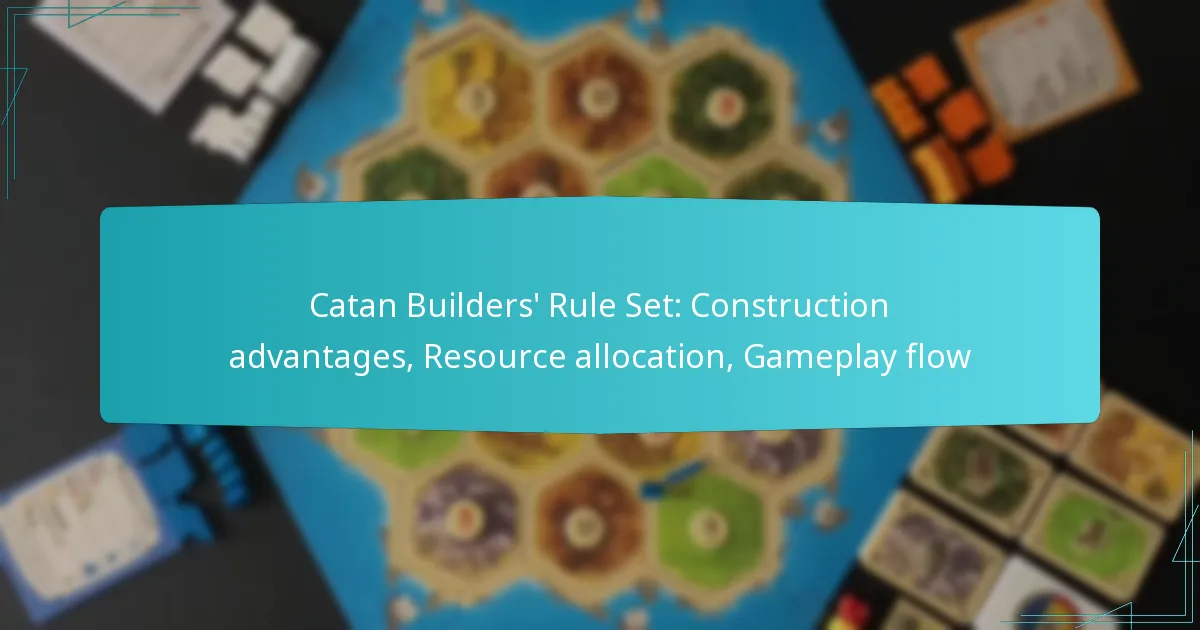
The Catan Builders’ Rule Set outlines the essential construction guidelines that enable players to build settlements, cities, and roads strategically. Mastering these rules not only enhances resource management but also improves gameplay flow, allowing players to gain a competitive advantage through effective placement and timing of builds. By prioritizing resource allocation and leveraging trade opportunities, players can optimize their construction efforts and elevate their overall game strategy.
What are the construction rules in Catan?
The construction rules in Catan dictate how players can build settlements, cities, and roads throughout the game. Understanding these rules is essential for effective resource management and strategic gameplay.
Building settlements: requirements and limitations
To build a settlement in Catan, players must adhere to specific requirements. Each settlement requires one brick, one wood, one wheat, and one sheep. Additionally, settlements must be placed at least two road lengths away from any other settlement, ensuring strategic spacing on the board.
Players should also consider the location of their settlements carefully. Settlements placed near high-yield resource hexes can significantly enhance resource production, while those in less favorable areas may hinder growth. It’s crucial to balance immediate needs with long-term positioning.
Building cities: upgrades and benefits
Upgrading a settlement to a city offers significant advantages. Each city requires three wheat and two ore, and it doubles the resource production from adjacent hexes. This means players can gather more resources per turn, accelerating their progress towards victory.
Cities also provide additional victory points, which are essential for winning the game. Players should prioritize upgrading settlements to cities when they have a stable resource flow, as this can create a powerful economic advantage over opponents.
Constructing roads: strategic placement
Roads are crucial for expanding a player’s territory and connecting settlements. Each road requires one brick and one wood. Players should focus on placing roads to secure key locations on the board, such as potential settlement spots or routes to valuable resources.
Strategic placement can also block opponents from expanding their networks. Players should consider both offensive and defensive road placements to maximize their control over the game board.
Special building conditions: exceptions and nuances
There are special conditions that can affect building in Catan. For example, players cannot build during their turn if they have reached the maximum number of settlements or cities allowed. Additionally, players must have the required resources on hand at the time of building.
Some game variations may introduce additional rules, such as the ability to build during specific phases or under certain conditions. Familiarity with these nuances can provide a competitive edge.
Building during other players’ turns: rules and strategies
Players can build during other players’ turns under specific circumstances, such as when they have the “Year of Plenty” card or the “Monopoly” card. This allows for strategic resource acquisition and can disrupt opponents’ plans.
However, players should be cautious when building during others’ turns, as it can lead to resource depletion or missed opportunities. Timing is critical, and players should assess the board state before making any decisions.
How can construction provide advantages in Catan?
Construction in Catan offers players strategic benefits that can enhance resource acquisition and gameplay flow. By effectively placing settlements, timing builds, and leveraging trades, players can gain a competitive edge over their opponents.
Optimal settlement placement for resource diversity
Choosing the right locations for settlements is crucial for ensuring a diverse resource base. Aim to settle near hexes that produce different resources, ideally covering all five types: wood, brick, wheat, sheep, and ore. This diversity allows for more flexible building options and trade opportunities.
Consider the probability of resource production as indicated by the numbers on the hexes. Settling near high-frequency numbers (like 6 and 8) increases the likelihood of resource acquisition. Additionally, placing settlements at intersections can maximize access to multiple resources.
Prioritize locations that connect to future expansion possibilities. This foresight can help secure additional settlements and roads, further enhancing resource flow and strategic positioning on the board.
Timing of building: maximizing resource flow
Timing your construction is essential for optimizing resource flow. Build settlements and roads when you have sufficient resources to do so, but also consider the turn order and your opponents’ potential moves. Constructing at the right moment can block opponents or secure critical paths.
For instance, if you anticipate a resource shortage in the upcoming rounds, prioritize building settlements to secure access before the board changes. Conversely, if you have a surplus of resources, consider building roads to expand your reach and secure key locations.
Utilizing the turn order effectively can also enhance your strategy. If you are last in turn order, observe your opponents’ moves and build in response to their actions, ensuring you capitalize on any gaps they leave open.
Leveraging trade opportunities through construction
Building settlements and roads can create valuable trade opportunities. When you construct near other players, you can negotiate trades more effectively by offering resources that they need. This can help you gain the upper hand in resource acquisition.
Establishing settlements near ports can also enhance your trading capabilities. Ports allow for more favorable trades, enabling you to exchange resources at a better rate than the standard 4:1. This can be particularly advantageous if you have an abundance of a specific resource.
Be mindful of your opponents’ trading needs as well. If you notice a player is low on a certain resource, you can use that knowledge to negotiate trades that benefit you while limiting their options.
Blocking opponents: strategic road placement
Road placement is a key strategy for blocking opponents and controlling the board. By building roads strategically, you can cut off access to valuable resources or limit your opponents’ expansion options. This can be especially effective when you anticipate their next moves.
Identify critical paths on the board that connect to high-value settlements or resources. By placing roads in these areas, you can prevent opponents from reaching those locations, forcing them to find alternative routes or settle for less advantageous spots.
Consider the potential for longest road points as well. Building longer roads not only blocks opponents but also positions you to earn additional victory points, which can be crucial for winning the game.
Utilizing development cards for construction advantages
Development cards can provide significant construction advantages in Catan. These cards can grant resources, allow for additional building actions, or provide knights to move the robber. Using development cards strategically can enhance your overall building strategy.
For instance, the Year of Plenty card allows you to take any two resources from the bank, which can be used to build settlements or roads when you are in a pinch. The Monopoly card can also be powerful, allowing you to collect resources from all players, potentially giving you the edge needed for construction.
Additionally, purchasing development cards regularly can keep your opponents guessing about your strategy. This unpredictability can prevent them from blocking your expansion or trading effectively against you.
What are effective resource allocation strategies in Catan?
Effective resource allocation strategies in Catan involve prioritizing the collection and management of key resources to optimize construction and gameplay. Players must consider their position on the board, the availability of resources, and trade opportunities to build settlements and cities efficiently.
Identifying critical resources for construction
In Catan, the critical resources for construction are wood, brick, wheat, ore, and sheep. Wood and brick are essential for building roads and settlements, while wheat is necessary for settlements and cities. Ore becomes increasingly important as players advance to cities and development cards.
Understanding the distribution of these resources on the board is vital. Players should aim to position their settlements on hexes that yield a variety of these resources, preferably with high frequency numbers (like 6 or 8) to maximize their chances of collection.
Resource trading: best practices and tips
Effective trading can significantly enhance resource allocation. Players should always be aware of their own needs and the needs of others, using this knowledge to negotiate favorable trades. Offering multiple resources for a single one can often sway opponents to agree to trades that benefit you more.
It’s important to establish a good reputation as a trader. Being perceived as fair can lead to better trades in the long run. Avoid making trades that overly benefit a player who is already in a strong position, as this can backfire and lead to a loss for you later in the game.
Managing resource scarcity: adaptive strategies
Resource scarcity can occur when key resources are monopolized or when dice rolls do not favor certain hexes. In these situations, players should adapt by seeking alternative strategies, such as focusing on development cards or expanding to new locations that offer different resources.
Players can also consider trading for scarce resources, even if it means giving up more than they would like. Sometimes, forming temporary alliances with other players can help mitigate scarcity, allowing for more favorable trade conditions.
Building a resource monopoly: advantages and risks
Establishing a resource monopoly can provide significant advantages, such as controlling trade and limiting opponents’ options. If you dominate a critical resource, you can dictate terms and demand favorable trades from others, enhancing your own construction capabilities.
However, monopolies come with risks. Other players may target you to break your advantage, leading to potential blockades or aggressive strategies against you. Balancing your resource control with maintaining good relationships is crucial to avoid becoming a target.
Using ports to enhance resource allocation
Ports are valuable assets in Catan that can significantly improve resource allocation. By building settlements near ports, players can trade resources at better rates, often converting less valuable resources into more critical ones. For example, a 2:1 port for wheat can be a game-changer if wheat is scarce in your area.
Players should prioritize acquiring ports that complement their resource strengths. If you have an abundance of a specific resource, securing a port that allows for favorable trades can help you leverage that surplus effectively, enhancing your overall strategy.
How does construction impact gameplay flow in Catan?
Construction significantly influences gameplay flow in Catan by altering player turn dynamics and resource allocation. Building roads, settlements, and cities not only enhances a player’s position but also affects the pace and interaction among players throughout the game.
Interplay between construction and player turns
In Catan, each player’s turn is a critical moment for decision-making regarding construction. Players must assess their available resources and determine the most strategic buildings to construct, which can include roads to expand territory or settlements to increase resource production.
Building during a turn can lead to immediate benefits, such as gaining access to new resources or blocking opponents from expanding. Players should consider the timing of their constructions, as building too early may expose their strategies, while waiting too long can result in missed opportunities.
- Prioritize building roads to secure key locations before opponents.
- Construct settlements near diverse resource tiles to maximize production.
- Balance short-term gains with long-term strategies to maintain a competitive edge.
Influence of building on game pacing and dynamics
The act of building can significantly alter the pacing of the game. When players construct frequently, the game progresses rapidly, leading to a more dynamic and competitive environment. Conversely, if players focus on resource accumulation without building, the game may slow down, allowing for more strategic planning.
Construction also fosters player interaction, as building near opponents can create tension and competition for resources. This interaction can lead to negotiations, trades, and even conflicts, which can further influence the game’s flow and player strategies.
To maintain an engaging pace, players should aim for a balance between building and resource management. Regularly assessing the board and adjusting strategies based on opponents’ actions can help keep the game lively and competitive.